
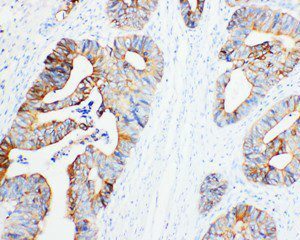
ROR1/NTRKR1 Polyclonal
$424.00
ROR1 and ROR2 are orphan receptor tyrosine kinases that are most closely related to MuSK and the Trk family of neurotrophin receptors. ROR1 (receptor tyrosine kinase-like orphan receptor 1), also known as neurotrophic tyrosine kinase receptor-related 1(NTRKR1), is a tumor-associated, surface protein predominantly expressed during embryogenesis, where it is involved in organ morphogenesis, nervous system development, and neural progenitor cell maintenance and survival. A 6-kb NTRKR1 mRNA is expressed strongly in human heart, lung, and kidney, but weakly in the CNS. However, a truncated 2.4-kb mRNA lacking extracellular and transmembrane domains was strongly expressed in fetal and adult CNS and in a variety of human cancers, including chronic lymphocytic leukemia (CLL), mantle cell lymphoma (MCL), acute lymphoblastic leukemia (ALL), marginal zone lymphoma, lung adenocarcinoma. Wnt-5a has since been suggested as a candidate ligand for ROR1, and ROR1 has been implicated to function as a pseudokinase, promoting proliferation and resistance to apoptosis in cancer cells through interaction with Wnt-5a, and TCL1-co-activation of AKT.
Clone
Polyclonal
Isotype
IgG
Host species
Rabbit
Species Reactivity
Human, Mouse, Rat
Cellular Localization
Membrane
Positive Control
Lung carcinoma
Applications
IHC, WB
Intended Use
Research Use Only