
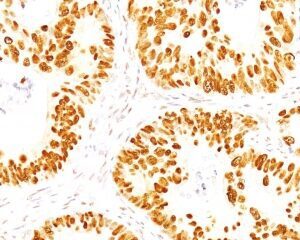
p53 [MD437R]
Price range: $375.00 through $656.00
p53 acts as both a tumor-suppressor and transcription factor that, upon activation by DNA damage and other cellular stress signals, leads to the transcription of genes triggering cell-cycle arrest, apoptosis, and DNA repair. p53 is overexpressed in over 50% of human cancers. Positive staining of p53 detected by immunohistochemistry has been observed in colon cancer, breast cancer, lung cancer, prostate cancer and ovary cancer.
Clone
MD437R
Isotype
IgG
Host species
Rabbit
Species Reactivity
Human
Cellular Localization
Nucleus
Positive Control
Breast carcinoma, colon carcinoma
Applications
IHC, WB
Intended Use
Research Use Only