
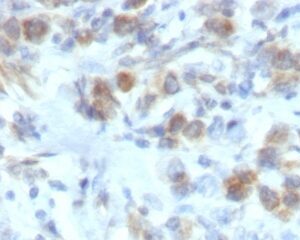
PAX6 [SPM612]
Price range: $269.00 through $520.00
Pax genes contain paired domains with strong homology to genes in Drosophila, which are involved in programming early development. Lesions in the Pax6 gene account for most cases of aniridia, a congenital malformation of the eye, chiefly characterized by iris hypoplasia, which can cause blindness. Pax6 is involved in other anterior segment malformations besides aniridia, such as Peters anomaly, a major error in the embryonic development of the eye with corneal clouding with variable iridolenticulocorneal adhesions. The Pax6 gene encodes a transcriptional regulator that recognizes target genes through its paired-type DNA-binding domain. The paired domain is composed of two distinct DNA-binding subdomains, the amino-terminal subdomain and the carboxy-terminal subdomain, which bind respective consensus DNA sequences. The human Pax6 gene produces two alternatively spliced isoforms that have the distinct structure of the paired domain.
Clone
SPM612
Isotype
IgG1k
Host species
Mouse
Species Reactivity
Human
Cellular Localization
Nucleus
Positive Control
Pancreas, cerebellum, stomach
Applications
Flow Cyt., IF, IHC
Intended Use
Research Use Only